

Rafael Nadal def. Nick Kyrgios 7-6(0), 5-7, 6-4
Where you return serve and where you rally are not the exact locations.
The 2022 Indian Wells quarter-final between Rafael Nadal and Nick Kyrgios offers a prime example of players’ different targets when returning a serve and developing a rally.
Return Of Serve
Players generally have a defensive mindset when returning first serves. The immediate goal is to return the ball back into the court and avoid an error. The highest percentage place to aim is right down the middle of the court, taking the singles sidelines out of the equation. Returning second serves is a more offensive situation, in which you can still attack deep down the middle and have greater confidence going wider.
2022 Indian Wells: Nadal v Kyrgios Return Location (Hawk-Eye)
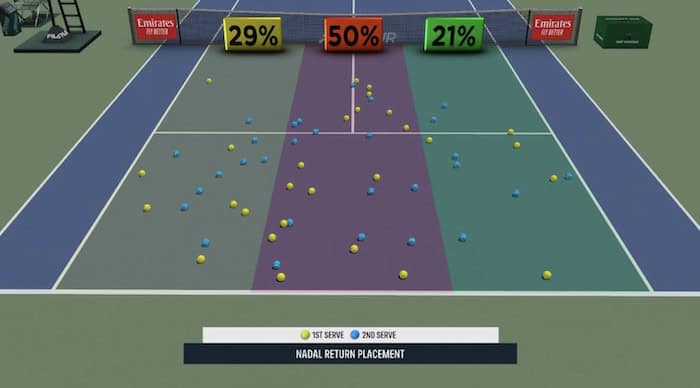
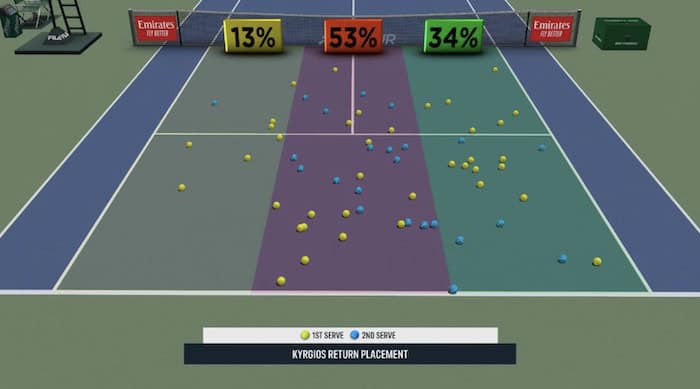
As you can see from the Hawk-Eye graphics above, both Nadal and Kyrgios targeted the middle third of the court the most when returning serve.
Nadal hit 50% of his returns right down the middle of the court, while Kyrgios hit 53%. The explicit goal is to get the ball in the court and land it in the middle of a big target. This strategy also yields a strong secondary element, as it does not automatically provide an angle for the server to attack with.
The second-highest location for each returner was the backhand third of the court. Nadal hit 29% of his returns to the wide third of the court to Kyrgios’ backhand, while Kyrgios directed 34% to Nadal’s backhand third of the court.
Middle first. Backhand second. Forehand last.
Both players employed this strategy. Solid logic.
Once the return was put back in play, hitting down the middle third of the court was no longer the preferred option, as you will see from the Hawk-Eye graphics below.
GET MENTALLY TOUGHER IN COMPETITION
Webinar 46: 8 Ways To Force An Error
Webinar 41: Opponent Awareness
Webinar 24: Andre Agassi Patterns Of Play
2022 Indian Wells: Nadal v Kyrgios Rally Location
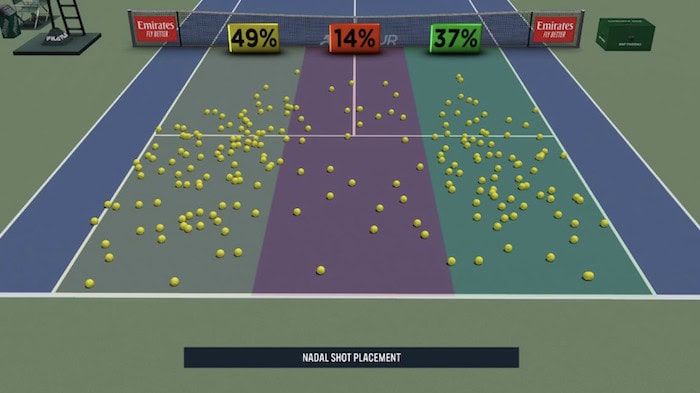
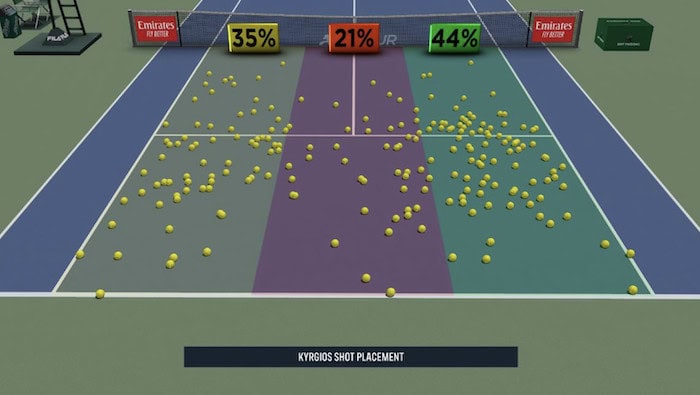
Nadal only hit 14% of his rally balls down the middle third of the court, while Kyrgios was a little higher at 21%. The primary target for both players was their opponent’s backhand. Nadal hit 49% of all groundstrokes at the wide third of the court to Kyrgios’ backhand, while Kyrgios hit 44% of his shots to out wide to Nadal’s backhand.
There is clear logic for this change in strategy between returning and rallying.
In the 25 Golden Rules of Singles Strategy, the role of the forehand and backhand are explained with a sword and shield metaphor. The forehand is the sword you attack with the most, and the backhand is the shield you generally defend with.
Two different shots. Two different roles.
What Nadal and Kyrgios were both trying to do was match up their sword with the opponent’s shield. That’s the optimal way to attack.
Here’s the average forehand and backhand speed for the match.
Average Forehand Speed
- Nadal = 71 mph
- Kyrgios = 73 mph
Average Backhand Speed
- Nadal = 66 mph
- Kyrgios = 68 mph
Both players averaged hitting forehands harder than backhands, and both players hit more total forehands than backhands.
Nadal Groundstrokes
- Forehands = 138
- Backhands = 119
Kyrgios Groundstrokes
- Forehands = 168
- Backhands = 93
The No. 1 goal of the forehand is to force an error. The No. 1 goal of the backhand is not to miss.
Does the return and groundstroke strategy from Nadal and Kyrgios wash down to the amateur level? You bet it does! Returning middle is an effective way to put more balls in the court and cut down angles. Taking your forehand to your opponent’s backhand will also give you a strategic edge from the back of the court as well.
Best,
Craig