


G’day,
Novak Djokovic is currently the third-best player on the planet.
Father time has caught up with him, and by his own admission, the brutal physicality of battling Carlos Alcaraz and Jannik Sinner over five sets has become an overwhelming obstacle.
Here are five key stats that Djokovic used to dominate his opponents. Now, they clearly highlight where he is struggling.
1: 0-4 SHOT RALLY LENGTH
Novak played almost two out of every three points (63%) in the 0-4 shot rally length at the 2025 US Open. It is incredible to think that Novak puts a maximum of just two shots in the court in the vast majority of points he plays, but that’s the reality of tennis at all levels.
Djokovic 2025 US Open Rally Length
- 0-4 Shots = 63.3%
- 5-8 Shots = 23.3%
- 9+ Shots = 13.4%
The other two longer rally lengths combined don’t even come close to the number of points he plays in the shorter rallies. After matches, we all obsess about the longer, more memorable rallies that we watched, and the shorter rallies tend to go into our short-term memory and are then easily forgotten.
To the semi-final against Alcaraz, Novak had amassed a 90-point advantage in the 0-4 rally length, winning 426 points while losing 347. In the semi, he got punished in this area, winning 56 points while losing 67. You can’t lose this critical match metric and expect to win the match.
Novak Djokovic 2025 US Open 0-4 Shot Rally Performance

Djokovic’s win/loss gap was far more dominant in shorter rallies than longer ones in New York.
- 0-4 shot rallies: 426 won/347 lost = +79
- 5-8 shot rallies: 147 won/138 lost = +9
- 9+ shot rallies: 90 won/74 lost = +16
Alcaraz was simply better in the first four shots of the point against Djokovic. It’s the serve, return, Serve +1, and Return +1 where the real gap exists.
2: BASELINE POINTS WON
Djokovic used to own the back of the court against all-takers. Not anymore.
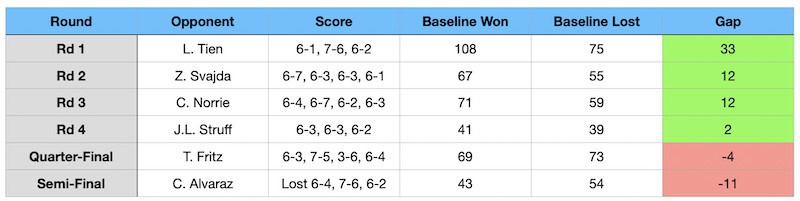
It was a warning sign that Novak slightly lost the baseline battle against Taylor Fritz by four shots (69 to 73). Alcaraz was able to extend his dominance from the back of the court to an 11-point gap, winning 54 points to Djokovic’s 43.
Djokovic has been able to stretch opponents to all parts of the baseline for well over a decade. He is now a step slower. You can see it in his speed to get to a wide ball, and you can see it in his recovery. It’s perfectly normal, and it must be infuriating for him not to get to balls with the same ease he always has.
3: RETURN POINTS WON VS 1ST SERVES
Djokovic is arguably the greatest returner our sport has ever seen. He is incredibly elastic and wins points against first serves by using the power of the serve against the server. Not yesterday against Alcaraz.
Novak was only able to win eight points against Alcaraz’s 56 first serves (16%) that he landed. That’s one-way traffic for the Spaniard.
On the flip side, Alcaraz won 19 of 56 (34%) of his first serve returns against Djokovic. Alcaraz was more than twice as good in this all-important match metric. Winning points against first serves is all about fast-twitch reactions with the hands and feet. Novak’s age is taking its toll in this specific area of his game.
4: NET POINTS WON
At 38 years of age, Novak would be wise to take the battle more to the front of the court, where he would have a better chance of pressuring Alcaraz. Success at the front of the court didn’t happen.
Net Points Won
- Djokovic = 54% (17/31)
- Alcaraz = 68% (15/22)
Djokovic went to the net more than Alcaraz, but he was not able to do any real damage, barely winning half (54%) of his net points. Again, this part of the game is all about the speed of the hands and feet with reaction time. It wasn’t there with the same proficiency we have become accustomed to seeing.
5: SERVICE GAMES STARTING 15-0
Tennis is a game of getting ahead and applying scoreboard pressure as a secondary opponent. One way to tip things in your favor is to win the first point of your service game to create an advantage. Djokovic didn’t. Alcaraz did.
Surging Ahead 15-0 When Serving
- Djokovic = 60% (9/15)
- Alcaraz = 87% (13/15)
Alcaraz was almost always enjoying a 15-0 start to his service games. It helped keep the pressure out of his service games and prevented momentum from slipping the wrong way.
Alcaraz started 0-15 in two of his service games. He held both of them. Djokovic started 0-15 in six of his service games. He was broken in two of them.
SUMMARY
Djokovic is now 38 years old. Every single player on the tour would hope to still be as competitive as the Super Serb is at the same age. Indeed, many players have little chance of playing to the same age due to injuries accumulating over the years.
In many ways, there are only two players in Novak’s way at the moment. And it’s incredibly difficult for him to beat Alcaraz and Sinner over the rigors of five sets. Novak has a much better chance in a Masters event, where he can come out guns blazing in a best two-out-of-three format.
Djokovic can still win a Grand Slam, but he clearly needs help. He needs Sinner and Alcaraz to get upset or pick up a niggle as they progress through two weeks of a Grand Slam draw. Then, the 38-year-old becomes the favorite, and his dream of winning another major title becomes far more possible.