

G’day from Wimbledon!
You know it’s coming. Your opponent knows it’s coming. It’s just a matter of when.
One of the most common, yet under-the-radar, ways players lose matches at all levels of our sport is simply dropping one bad service game.
One bad service game can undo a dozen good ones. It may be because you are nervous, or lost focus, or were hijacked by the moment. It could certainly mean you are reaching for the finish line instead of being locked in on your winning strategy.
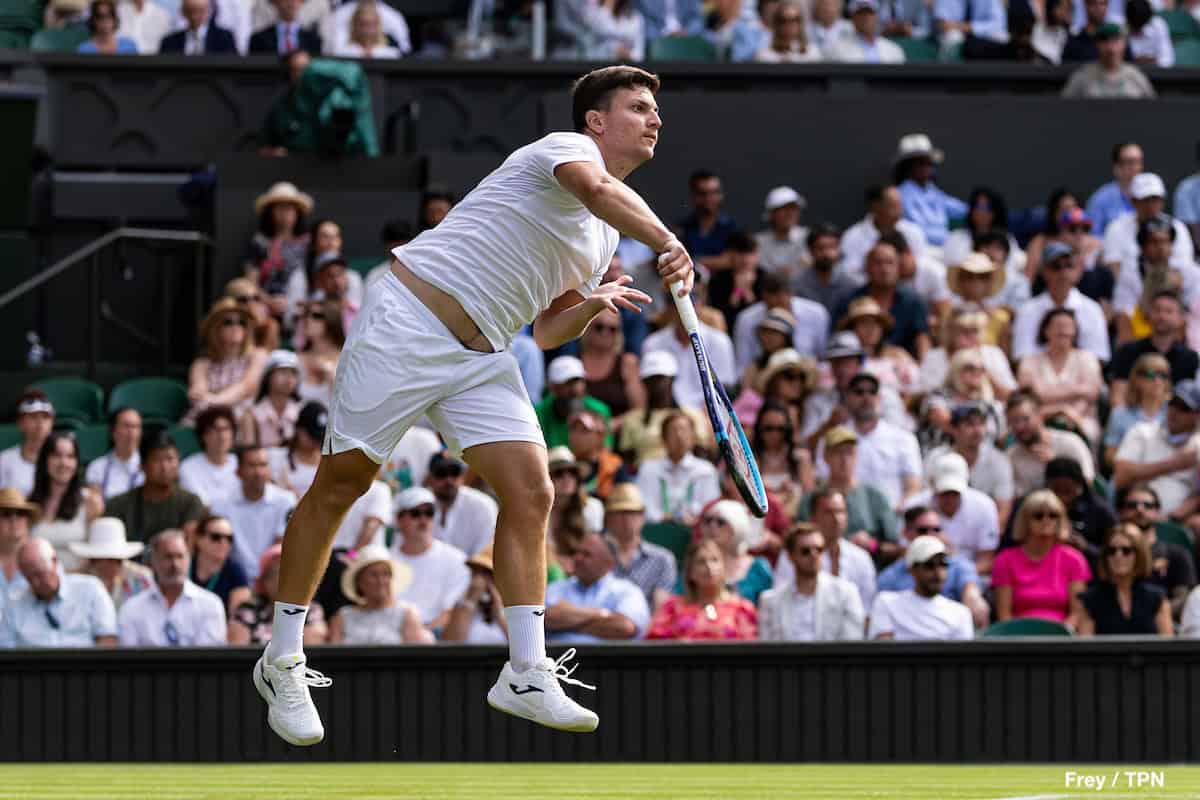
Miomir Kecmanovic was going toe-to-toe with Jannik Sinner in their opening round match at Wimbledon on Monday and was right in the mix, serving at 2-3 in the 5th set. He was playing well. An upset was definitely possible. And then it arrived in all its glory. One bad service game cost him victory.
Let’s go through it point by point.
KECMANOVIC SERVING 2-3 FIFTH SET
Love All – Kecmanovic made a first serve, but played a passive baseline point hoping Sinner would miss. He didn’t, and Kecmanovic ended up committing a forehand error wide in the Deuce court. He didn’t drop the hammer with two run-around forehands earlier in the point, and Sinner made him pay for it.
Losing the first point of the game helps set the (bad) weather for the rest of the game. That certainly happened here.
Love-15 – Kecmanovic got lucky with a Serve +1 backhand net cord that Sinner couldn’t get back over the net.
15-All – Kecmanovic again started with a neutral serve +1 backhand, and Sinner jumped all over the easy ball and dispatched it down the line for a backhand winner. The ball sat there and deserved the punishment.
15-30 – Kecmanovic was feeling the heat. He hit his first serve in the net and then followed up with a second serve in the net. These are the calling cards of a bad service game.
15-40 – Down 15-40, Kecmanovic made a first serve but again started the point with a Serve +1 backhand. Sinner again went down the line with his run-around forehand and extracted a forehand error in the net. The bad service game was complete.
Sinner now led 4-2 and held his next two service games to 15. Once he broke for the 4-2 lead, the match officially ended. Sinner didn’t play a great game to break, but he certainly put the ball where he wanted (to Kecmanovic’s forehand) to let Kecmanovic commit the errors he needed.
SUMMARY
The bad service game for Kecmanovic started with a 0-15 deficit. Here’s exactly what that meant.
2026 Wimbledon Men: Winning The First Point Serving
- Overall Holding Serve = 79%
- Holding from 0-15 = 64%
- Holding from 15-0 = 87%
Kecmanovic really needed to win the opening point to surge ahead 15-0 and enjoy an 87% chance of holding serve against the world No. 1 in the deciding fifth set. He didn’t, and things unraveled from there.
Here’s Kecmanovic’s win percentages from each point score he played.
- Holding from 0-0 = 79%
- Holding from 0-15 = 64%
- Holding from 15-15 = 75%
- Holding from 15-30 = 58%
- Holding from 15-40 = 27%
By the time he got to 15-40, he had about a one-in-four chance of holding serve and staying in the match. What hurt him the most? Probably serving two balls in the net to double fault. It was the worst possible way to lose a point.
If Kecmanovic didn’t drop that bad service game at 2-3 in the 5th set, he may very well be playing #48 Nuno Borges in the second round on Wednesday to then play the winner of #81 Jenson Brooksby and #34 Ignacio Buse for a spot in the round of 16, where the highest seed still alive is #23 Rafael Jodar.
There is a massive opportunity written all over this draw. Kecmanovic is currently ranked #58 in the world. Making the fourth round is worth 240 points and would have elevated Kecmanovic 20 spots up to around #38, and put almost USD $400,000 in his pocket.
One bad service game can be more costly than you could ever imagine.