

G’day from Wimbledon,
Time is the enemy. It’s also your best friend. Funny how that works.
Time is a key component of our great sport. How much time does our opponent allow us to prepare for the next shot? How much time do we have to get our hands and feet organized? How much time do I need between points so I don’t feel rushed?
This year, Wimbledon is tracking four metrics that revolve completely around time – or the lack of it. Let’s dig in and see what we can learn from all men and women in the round of 16.
MEN: AVERAGE SERVICE GAME LENGTH = 2m 44s
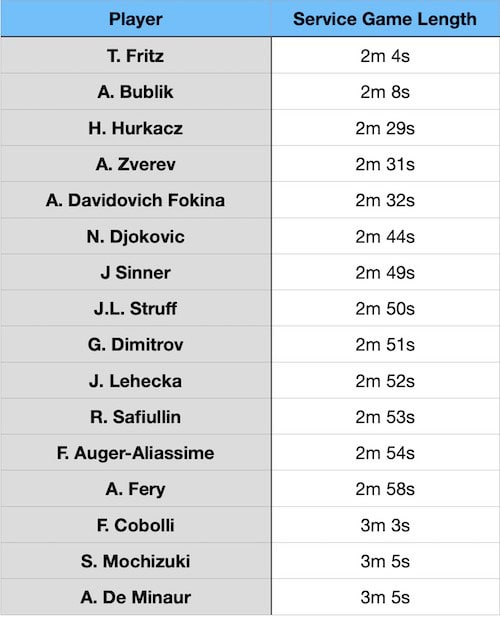
There is over a minute difference between the average times of service games between Taylor Fritz (2m 4s) and Alex De Minaur (3m 5s). What’s intriguing here is that both are manipulating time to their benefit. Fritz ikes to rush through service games and dominate with powerful first serves that don’t come back in play. He does not give opponents the time to strategize. They are just reacting.
At the other end of the spectrum, Cobolli, Mochizuki, and De Minaur all take over three minutes per service game on average. They are constricting you like a python. They control the tempo and the time and stretch things out while suffocating you with their consistency and defense. There is also a layer where Cobolli, Mochizuki, and De Minaur are having to go deeper in their service games because opponents are winning more points. Their serve is not their main weapon, so opponents can drill deeper.
What’s so good about our sport is that short and long both work. Taking time away and adding time both have their place on the world’s biggest stage.
IMPROVE YOUR ODDS OF HOLDING SERVE
Webinar 3: Serve Strategy And Patterns
Webinar 21: Serve And Volley / Return And Volley
Webinar 34: The Eight Serve Locations
Webinar 54: First Point Of The Game
MEN: AVERAGE TIME BETWEEN POINTS = 20s
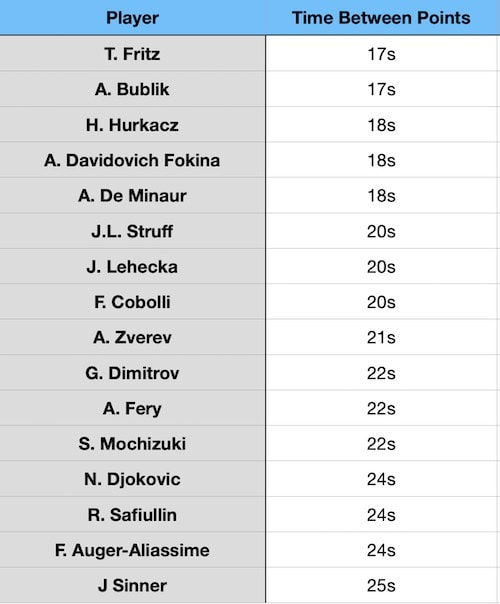
Fritz and Bublik are in a race to get things done. In a race to manipulate the point before it even starts by making you rush at the beginning. Smart. On the other end of the spectrum, Djokovic, Safiullin, Auger-Aliassime and Sinner want to make you wait. They control when a point starts. Not you. It’s a great way to make opponents wait and wait and overthink and self-implode.
MEN: AVERAGE TIME TO 2ND SERVE = 11s
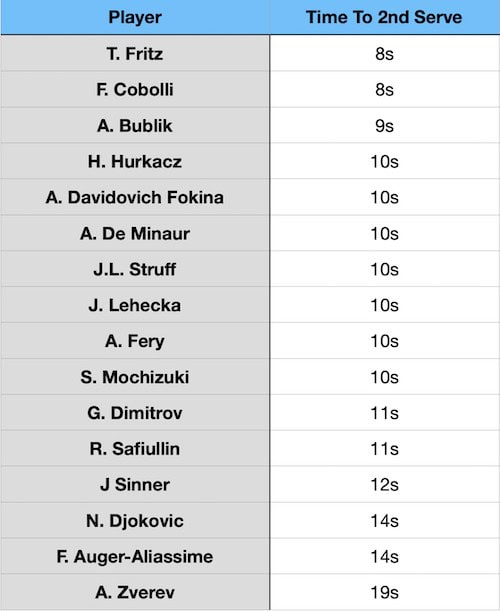
It’s pretty remarkable that Zverev is taking sooo much more time than any of the other players. Fritz, Cobolli, and Bublik all average taking HALF as much time as Zverev does. Does this beg the question regarding a serve clock for second serves as well? Zverev is very successfully trying to make you wait and wait and wait for his second serve. He controls time by repeatedly bouncing the ball and not serving until he is ready – and you are probably annoyed for having to wait for so long.
MEN: AVERAGE RALLY DURATION = 8s
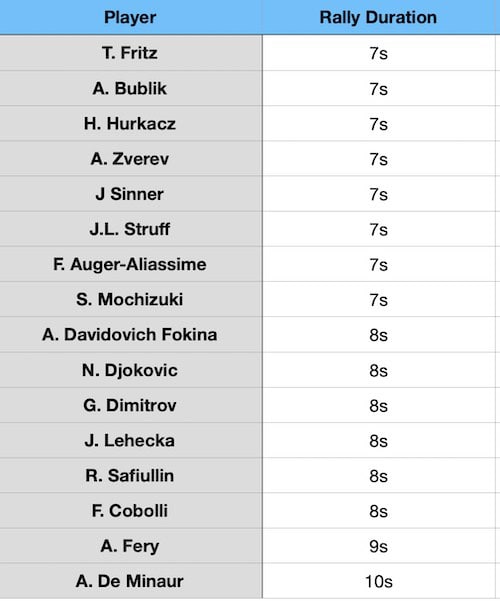
We all get the feeling that De Minaur likes to battle in longer points and use his legs and lungs to his advantage. Two key problems with continually extending the rally is fatigue (mental and physical) and injury. De Minaur has been susceptible to both. There is not much difference once the point starts, but players who like to take time away, such as Fritz and Bublik, do so while the ball is in play and between points. They never let up.
WOMEN: AVERAGE SERVICE GAME LENGTH = 3m 6s
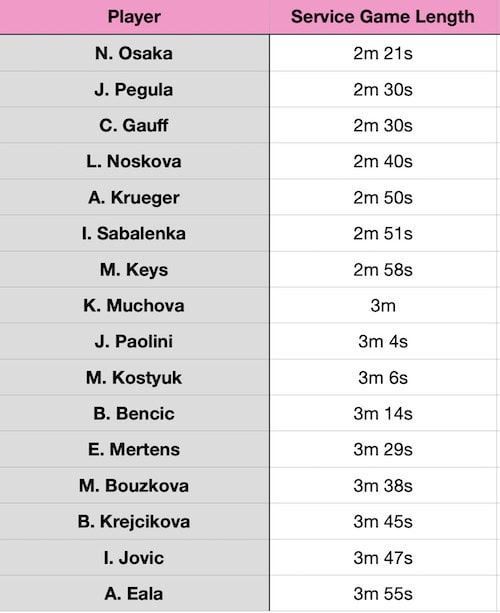
Nomi Osaka is the female version of Taylor Fritz in this time analysis. She plays the shortest service games, by far, trying to attack opponents before they know what’s happening and how to create a game plan against her time-shortening strategy. Eala is the longest, which is probably a combo of her trying to play at her pace and opponents going deep in her service games and pushing the point score past Deuce.
WOMEN: AVERAGE TIME BETWEEN POINTS = 21s
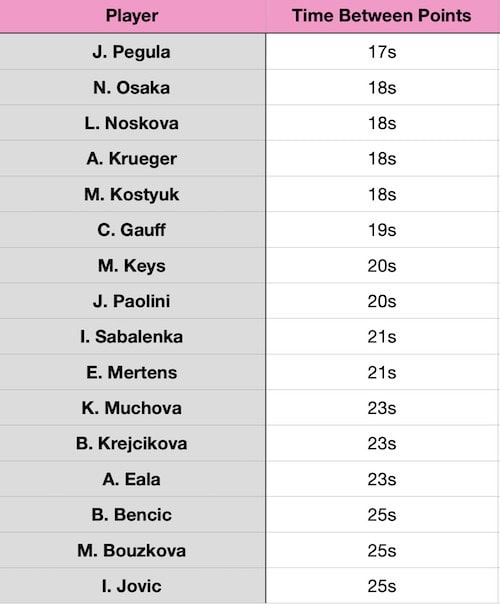
Pegula and Osaka are once again leading the pack of Rd16 players enjoying short service games and also getting on with it between points. They are not interested in milking the clock. They are interested in taking your time away to figure out what’s going on. On the flip side, Jovic, Bouzkova and Bencic prefer to string things out and control time. They probably want to annoy opponents by how long they take, which is still within the rules.
WOMEN: AVERAGE TIME TO 2ND SERVE = 13s
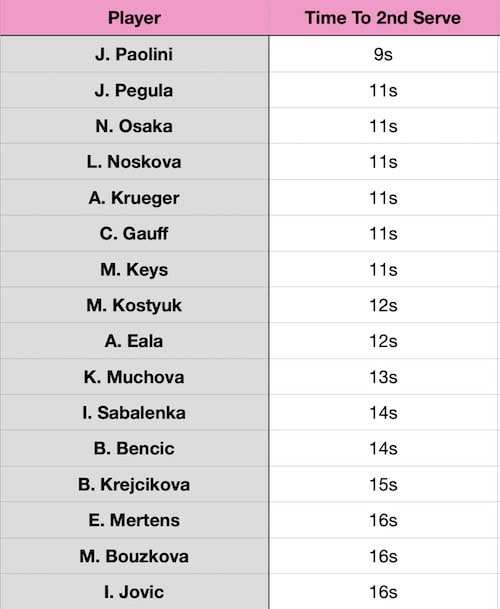
If Paoline serves a first serve fault, she is the quickest at getting back into position and delivering her second serve. This is probably more about her preferred quicker rhythm than about trying to mess up opponents.
Jovic, Bouzkova and Mertens all take the longest amount of time to hit their second serve after a first serve fault. They want to make sure all their ducks are in a row. Bouncing the ball. Breathing. Planning. They want to get it all done in the required time.
WOMEN: AVERAGE RALLY DURATION = 8s
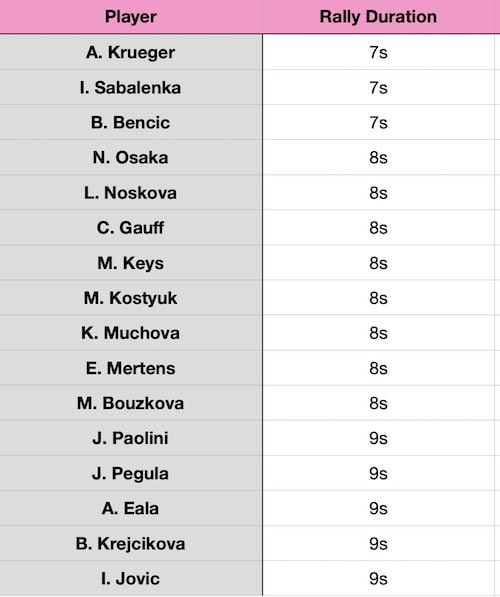
There is only a three-second difference between slowest and fastest average rally durations. It’s interesting to note that the players who are slowest between points tend to be the slowest during points. Want to play short points? Also, be quick between the points.
SUMMARY
Like a lot of new data, you don’t really know what it means, or how important it is when you first absorb it. But the more we look into this specific area of our sport, the more we will understand the importance of taking time away from, or adding time to, the match. Some players want to get things done and dusted quickly. They either love a faster rhythm, or want to make their opponent play faster to take them out of their rhythm.
Other players want you to wait. They want to get under your skin because you can’t play at the speed you like. You are always waiting during points and having to hit more shots in longer rallies.
Time helps players work both ways. What’s your ideal rhythm? Which one of these male or female players do you connect with the most?